


At this workshop,
CDF presented preliminary results on the measurement of events where two
scattering processes occur in the same event [20].
For distinct processes A and B, the cross section
for this ``double parton (DP) scattering" is given by
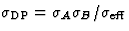 , where
 is a process independent parameter.
Events were selected with a relatively low transverse energy (ET> 16 GeV)
``photon" trigger
in conjunction with three jets with ET> 5 GeV.
The separation of DP events from the underlying QCD background is determined
by studying variables sensitive to decorrelation effects.
In particular,
the azimuthal angle between the two best-balancing pairs (``photon"+jet versus
dijet) is approximately flat for the DP signal and enables a statistical
separation of events.
A new feature of this analysis is that events with displaced
vertices, where the jets are reconstructed from separate origins,
are used to evaluate  directly and hence reduce the theoretical uncertainties.
This allows the first relatively precise determination of the effective
cross section:

 20%.
Assuming a uniformly
dense ball of partons and using the measured inelastic
 cross
section, one expects
 11 mb.
The measurement represents a milestone in the study of multiple interactions
and provides the first significant experimental constraint on such processes.
Multiple interactions, where two or more partons interact in the same event,
represent a considerable uncertainty in the analysis of photoproduction
events at HERA.
In particular, the extraction of the gluon content of
the photon at relatively low  requires careful modelling of
these interactions, since they can contribute up to 50% of the
cross section at the relatively low ET values (ET>6 GeV) measured
so far.
The Tevatron result should aid in a realistic estimate of the
uncertainties due to multiple interactions in the extraction of the
gluon density of the photon at HERA. Similarly, such measurements
improve background estimates to di-boson and boson+jet production at
the Tevatron as well as the predictions of jet rates from multiple
interactions at the LHC.
latex2html conversion by www person on 1997/08/13