BMU studies
Fake rates
A comparison of fake rates between BMU-fiducial tracks selected
using a crack-track selection and a BMU selection:
I take all tracks that have track and calorimeter isolation < 0.2,
are fiducial to the BMU (FidX<0 and FidZ<-3), and do not form a
Z with another muon candidate in the event (76-106). These form
the fake rate denominator.
I then apply full BMU cuts: track and cal iso < 0.1, EM<2+max(0,0.0115*(pt-100)),
Had<6+max(0,0.028*(pt-100)), 3 or more ax hits (2 for |eta|>1.25), 2 or more st hits,
d0<0.02 with Si or 0.2 no Si, BmuDx<9.
The ratio is the "BMU" fake rate.
Alternatively I apply the crack track cuts: track and cal iso < 0.1,
3 or more ax hits (all eta), 3 or more st hits,
d0<0.02 or 0.2, and chi2/dof<=3.
Using the same denominator as before but this redefined numerator gives the "Track" fake rate.
I investigated W->ev and W->uv background subtraction and found it negligible.
The "BMU fake rate" is less than half the "Track fake rate".
Jet20:
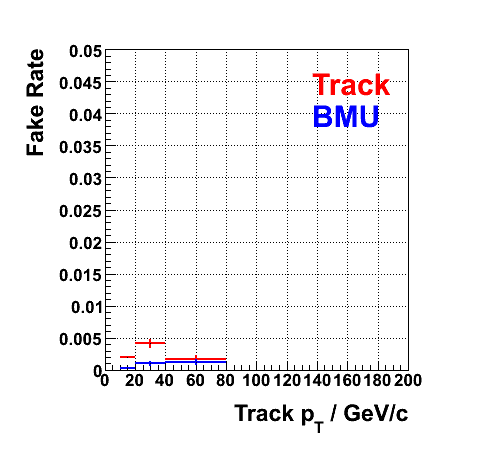 .eps
.C
Jet50:
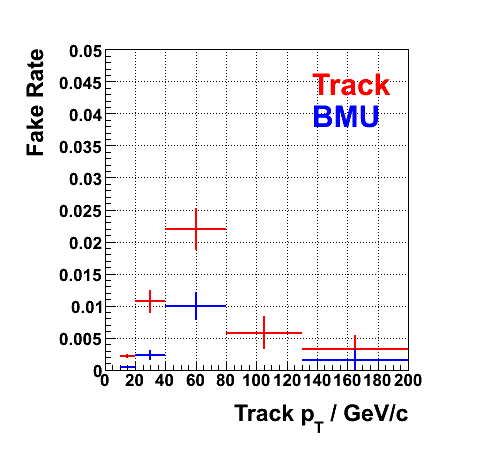 .eps
.C
Jet70:
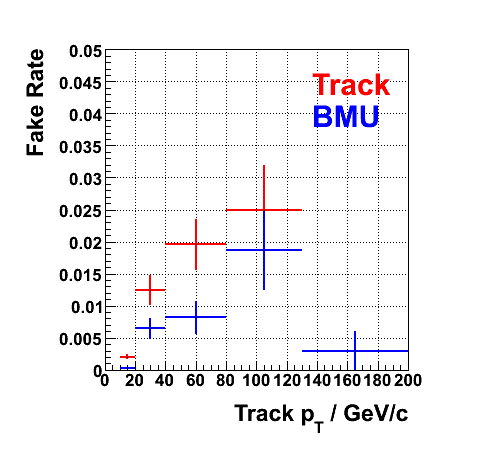 .eps
.C
Jet100:
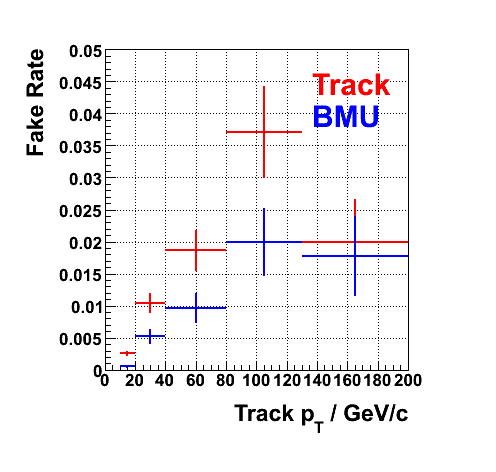 .eps
.C
Stubbed muon acceptance
A recent run of my selection scheme shows an 11% increase in stubbed muon category
acceptance for HWW signal (mH=160, dhgs1f p0-11) when including BMUs (of course most of
these have migrated from crack track or CMIOPES so it is not a net 11% acceptance
increase - but as shown above these are cleaner).
Stubbed	muon categories:

BMU categories:
CMUP_BMU :0.0884838
CMX_BMU	 :0.0416461
PHX_BMU	 :0.0519088
TCE_BMU	 :0.166752	0.3487907

Non-BMU categories:
CMUP_CMP :0.130086
CMUP_CMU :0.109452
CMUP_CMUP:0.265409
CMUP_CMX :0.250833
CMX_CMP	 :0.0554681
CMX_CMU	 :0.0388753
CMX_CMX	 :0.0432238
PHX_CMP	 :0.0341044
PHX_CMU	 :0.0365882
PHX_CMUP :0.181353
PHX_CMX	 :0.123833
TCE_CMP	 :0.27274
TCE_CMU	 :0.199835
TCE_CMUP :0.959799
TCE_CMX	 :0.441156	3.1427558


0.3487907/3.1427558 = 0.110982438 increase