


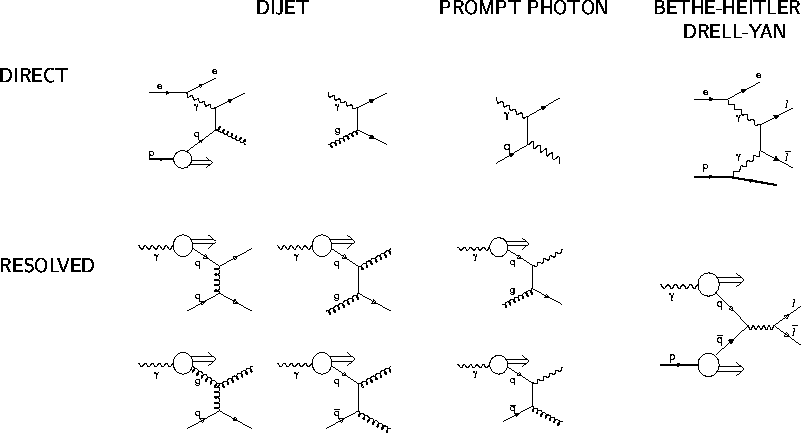
A problem concerning measurements of this type concerns the effects of final state QCD radiation, or higher order QCD effects in general. These are reduced if we can measure processes in which the emerging particles from the QCD subprocess are not themselves subject to QCD effects. Two classes of process which have been used in this way in hadron collisions are those in which high-pT photons are produced, i.e. so-called ``prompt" photons, and those in which quark-antiquark annihilation gives rise a pair of leptons, known as Drell-Yan processes. Fig. 1 illustrates the different types of process. In ``dijet" processes, both final state particles in the basic diagram are quarks or gluons, while the others involve a photon or a pair of leptons.
In  collisions at Fermilab, prompt photon processes provide a
way to study the gluon content of the proton [1,2]. At HERA,
the accessible kinematic range restricts the main sensitivity to
the quark content of the photon [3-6], together with the quark and
gluon contents of the proton. The particular virtue of prompt
photon processes is that the observed final-state photon emerges from
the QCD process directly, without the intermediate hadronisation that
accompanies the
observation of a quark or gluon through the means of a final state jet.
This, together with the availability of NLO calculations [7,5],
makes such processes attractive in providing the prospect of
a relatively clean technique for studying QCD. On the
other hand, the cross sections are substantially lower than those of
dijet processes.
Drell-Yan (DY) processes in photoproduction are by definition
resolved at LO. There is no exactly parallel class
of direct events, but a background comes
from Bethe-Heitler (BH, ``photon-photon") processes, as illustrated in
Fig. 1. (A further BH diagram, not shown, has an inelastic excitation of
the proton at the lower vertex.)
Both BH photons interact in a direct way in producing the lepton pair.
Direct-resolved and resolved-resolved photon photon interactions can also occur
and give hadronic final states. A higher order ``direct" DY diagram
can also be drawn in which the photon remnant is replaced by a
high-pT  or q [8].
 |
The study of lepton pair production through DY processes is of interest
because it can provide a further alternative way to measure the parton
densities of the photon and the proton, testing perturbative QCD and the
determination of the running coupling constant. It is also an important
background process for other
production mechanisms of lepton pairs, such as  and
 decays.
The twist-two chirality violating proton structure function h1(x)
can be measured in the DY reaction when both beam and target are transversely
polarized. In the framework of the nuclear program at HERA the DY reaction will
allow investigation of the violation of charge symmetry in the valence quark
distributions of the nucleon at large x, and tests of SU(2)-flavour symmetry
breaking.
In 1971 Jaffe [9] suggested that the photon structure function could be determined through the DY process in photoproduction experiments. Since then, several other authors have studied lepton pair production theoretically using the QCD formalism at kinematic conditions at fixed target experiments [10], as well as ep colliders such as HERA [11]. Much attention was paid to find proper kinematic variables and to determine a kinematic region where the major contribution from the DY leptons would not be dominated by the background processes. All of them, however, reached the not very comforting conclusion that, because of the overwhelming Bethe-Heitler background, photoproduction of lepton pairs from a proton target is not an adequate way of measuring the photon structure function through the DY effect.
The planned HERA upgrade, however, will increase the
integrated luminosity by two orders of magnitude
and allow stricter selection criteria to separate the processes of interest.
The conclusion of [11] for HERA
was based on a comparison of inclusive spectra (pT and rapidity),
calculated for  geometry without taking into account the acceptances
of the H1 or ZEUS detectors. One should therefore make an effort
to analyse the Drell-Yan and background processes using a more precise
approach to the experimental conditions. Results presented below show
that it is possible to find kinematic criteria under which
the Bethe-Heitler background is totally suppressed.
latex2html conversion by www person on 1997-08-14