


 is defined as the fraction of the photon
energy taking part in the hard QCD subprocess, and is a powerful tool
in characterising high energy photoproduction processes [13,14].
For direct processes its value is by definition unity. Experimentally,
its distribution is expected to differ markedly between
dijet processes and prompt photon processes.
An ``observed" value of may be evaluated,
using the definitions of [13] and [6],
as
 , summing over
particles (or calorimeter cells) in the jets
(or the jet plus the photon) and in the whole event,
for dijet events or prompt photon events as appropriate.
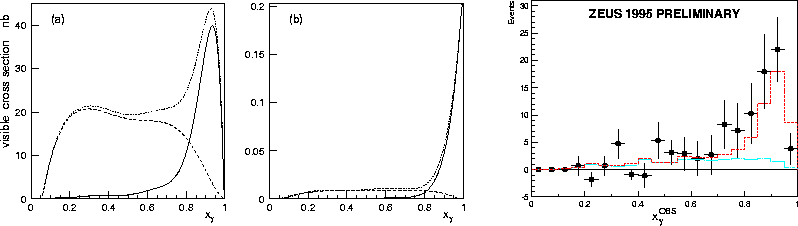 |
Figure 2 shows the difference between
the distributions of the
``observed" value of between dijet events and events
with a prompt photon and an accompanying high-ET jet,
subject to the typical kinematic constraints of a HERA experiment.
High ET jets have been reconstructed (ET > 5 GeV) from the
four-vectors of HERWIG simulations of direct and resolved events,
with jets and prompt photons (also ET > 5 GeV) accepted in the
pseudorapidity range 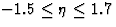 .First experimental results from ZEUS have been reported at the Rome DIS 96
Workshop [15]. In round figures, an integrated luminosity
of 6 pb-1 gives approximately 50 direct events with a prompt photon
in the ZEUS barrel calorimeter and 30 resolved events, an accompanying
jet also being observed.
The Direct Compton diagram gives a good measurement of the quark content of the proton, but an even more important aim is to measure the photon structure by means of the resolved events. With an integrated luminosity of 1000 pb-1 we may thus expect to record around 5000 resolved events and 7500 direct events with a prompt photon and a jet. This should suffice to give a reasonable measurement of the photon quark density and distinguish between present models which currently give cross sections differing among themselves by typically 10-20% [6]. Such measurements would be noticeably degraded if the total integrated luminosity were less, say, by a factor of 4. Use of photons detected in the rear calorimeter would give a small improvement, but not in the numbers of resolved events. To improve the resolved statistics we would require a better understanding of photon detection in the forward calorimeter. This is technically difficult, however, and its viability needs further study.
An alternative possibility would be to use inclusive prompt photon
distributions. These [4] appear to give a better sensitivity
to the photon structure, different models varying by as much as 40%.
The inclusive cross section for prompt photons within a pseudorapidity
range of  is given by [4] as 24-34 pb for the
resolved contribution, with a similar figure for the direct.
An integrated luminosity of 1000 pb-1 will then give
around 30k events in each category, the gain coming by an avoidance
of the need to detect the jet. However to take advantage of these
statistics, it would still be necessary to distinguish
somehow between direct and
resolved events. One way to do this is to model the photon remnant in
terms of energy detected (outside any high ET jets)
in the rear regions of the detector,
with the aim of reconstructing approximately for each event.
First investigations have been made [16] but the
technique is clearly more difficult than if the outgoing jet is detected.
For this reason, it seems necessary at present to aim for an measurement,
for which the highest possible luminosity is required.
latex2html conversion by www person on 1997-08-14