


 production
in ep collisions
(Ee=26.7 GeV, Ep=820 GeV) was simulated by
PYTHIA5.7 (for DY leptons) and LPAIR [17] (for
BH leptons). This allows us easily to apply all the
necessary cuts to account for detector resolution and detector geometry.
The results presented here are correspond to the geometry of the
ZEUS detector and are based on samples of
 events (for DY pairs) and 105 events (BH pairs).
To study the effects of different selection criteria on the background
suppression, cuts on the the polar angle  and energy
El of produced leptons were defined as follows:
1L
 ;
1L
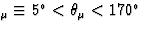 ;
2L
 ;
2L
 ;
1E
 GeV, 1E5
 GeV, 2E
 GeV.
These conditions correspond to lepton acceptances in the ZEUS detector.
Two types of trigger were considered:
a) ``tagged", requiring the detection of the
scattered electron (5<Ee'<25 GeV) at very small
angles, thereby limiting Q2 to less than
0.02 GeV2, and b) ``untagged", requiring the
absence of a detected scattered electron in the main
rear calorimeter (Q2< 4 GeV2).
The total ``untagged" and ``tagged" cross sections for photoproduction of DY pairs with masses Ml+l->1 GeV were found to be 84 pb and 25 pb respectively.
| PYTHIA | PYTHIA | PYTHIA | ||
| TRIGGERS | 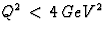 |
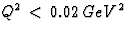 |
|
LPAIR |
 |
||||
| No Cuts | 20 000 | 20 000 | 7 125 | 105 |
| 1L | 14 301 | 14 099 | 5 903 | 54 569 |
| 2L | 12 475 | 12 248 | 3 974 | 44 649 |
| 1E | 15 560 | 15 589 | 5 221 | 5 801 |
| 1E5 | 8 874 | 9 058 | 2 209 | 1 050 |
1L 1E |
9 824 | 9 693 | 3 997 | 8 |
| 2L2E |
5 771 | 5 609 | 2 439 |
Table 1 presents numbers of events with electron pairs passing the
different combinations of cuts defined above.
From the last column of the
table it can be seen that the requirement of
detecting at least one of the BH electrons in the calorimeter
(1Le1E) dramatically reduces the number of
BH events passing this cut. With simultaneous detection of both
electrons (2Le2E) only about 12 of the DY electron
pairs survive, but the BH background is
totally eliminated. The ZEUS muon detector system has a smaller angular
acceptance and so the number
of DY muon pairs passing the 2L
 2E cuts is 1548 events of
 .
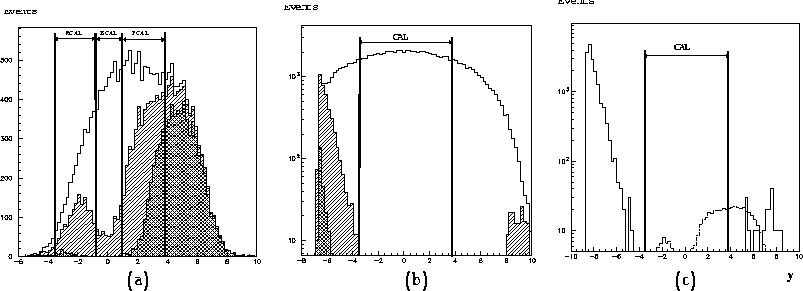 |
Figure 3 illustrates these results and shows
the (pseudo)-rapidity distributions of DY and BH leptons (i.e. electrons +
muons) under different trigger conditions. The final plot summarizes the
results of our analysis; at an integrated luminosity of
10 pb-1, with the 2L2E cuts
in the ZEUS detector, about 40 events can be detected with DY electron pairs
and 25 events with DY muon pairs. With
an integrated luminosity of 1000 pb-1 these data samples will increase by
two orders of magnitude, which should just be sufficient to enable
the photon structure to be investigated.
A further feature which could be used to distinguish DY from BH events
is the presence of a photon remnant. This can be quantified once again by evaluating
 (in terms of the two leptons instead of jets). The BH events will
have
 ; must be evaluated in any case for a
study of the photon structure, and a cut to remove high events should
help to remove the BH background and perhaps allow other conditions to be
loosened. We have not had time to investigate this question further, but it is
clear that a number of possibilities exist for studying DY pairs at HERA. All
require the highest luminosities that can be obtained.
latex2html conversion by www person on 1997-08-14