


The Tevatron
Collider provides a unique opportunity to study the properties of hard
interactions in  collisions at short distances. The production of jets
at large ET and its comparison with perturbative QCD calculations are of
interest as they can serve as a test of the elementarity of the
partons.
The CDF and DØ collaborations have measured jet cross sections over ten
orders of magnitude in  up to ET = 500 GeV, half way to
the kinematic limit. The challenge of measuring such a steeply
falling spectrum is the understanding of the energy calibration of
jets. The highest ET jets are not directly calibrated, resulting
in large uncertainties. In this kinematic region
the NLO calculations are well understood
at the 10-20% level. However, precise
knowledge of the parton distribution functions in the proton
is required before firm conclusions can be drawn from the comparison of data
and theory.
Collider data can
constrain the parton distribution functions in the
proton and especially the gluon distribution at moderate x. Kosower
presented a formalism to make such an extraction possible using NLO
calculations, while minimising the amount of numerical computation
involved [26].
The preliminary (published) inclusive jet cross sections as measured by
CDF using the 1994-1995 (1992-1993) data sample in the pseudorapidity
region of 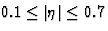 are compared to the NLO QCD in
Fig. 5(a) [27,28].
The latter are based on calculations by
EKS [29]
with CTEQ3M [30] parton densities, renormalisation
and factorisation scales
 , and the standard Snowmass jet
cone algorithm.
The data and the prediction are in excellent
agreement for ET < 250 GeV; at higher ET, however, the data lie
significantly above the predictions.
![\begin{figure}
\centering
\mbox{
\subfigure[CDF data vs. theory]
{
\psfig {figu...
.... theory ]
{
\psfig {figure=d0_inc_lin.eps,width=.45\textwidth}
}
}\end{figure}](img42.gif) |
DØ presented updated inclusive jet cross sections
in the region of  with significantly
reduced systematic uncertainties (by about a factor of two),
coming from a re-evaluation of the jet energy
scale corrections [27].
As shown in Fig. 5(b), these results are in
excellent agreement with NLO QCD over the entire ET range. DØ compares
the data to NLO QCD predictions using JETRAD [31],
the CTEQ3M parton densities, the
renormalisation and factorisation scales
 , and a modified Snowmass jet cone algorithm with
 =1.3.
It should be noted that the DØ and CDF data have been compared to NLO
QCD with slightly different input parameters which can introduce
an ET-dependent variation of  on the theoretical
predictions [27].
Also the two measurements probe different
 regions.
In order to
compare directly the results of the two experiments,
DØ also performed the analysis in the CDF region.
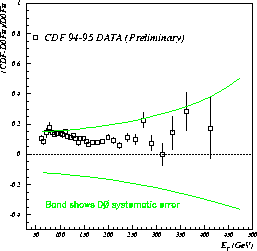
Figure 6 shows the CDF data points as compared to a fit of the
DØ data in the
region. The error band corresponds to the DØ systematic error which is mainly due to the jet energy scale uncertainty. The
CDF data lie above the DØ fit but are within the experimental uncertainties.
For a more
quantitative comparison between the two experiments,
the correlations in the systematic uncertainties of the two data sets
must be taken into account.
 |
The dijet angular distribution is an ideal tool to determine whether any
possible excess of events in high-ET inclusive jet production is
due to new physics effects.
The angular distribution of the outgoing
partons is strictly governed by the helicities of the partons
participating in the hard process
and is relatively insensitive to the parton densities.
Any unusual contact interaction (with effective scale  ) will
flatten the centre of mass
scattering angle distribution (or create an excess of events at low
 ).
The CDF published results on dijet angular distributions give a lower limit
of
 TeV.
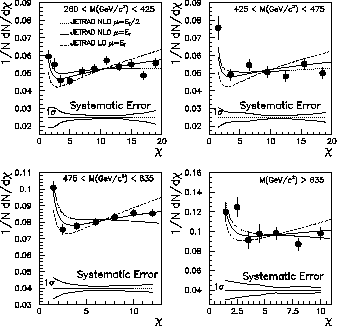
Figure 7 shows the
recent DØ distributions which are in good agreement
with NLO QCD [27].
Using these data,
DØ rules out at 95% CL a model where quarks couple with a universal
contact interaction of scale
 TeV.
 |
latex2html conversion by www person on 1997/08/13