


 |
Recently, much interest has been focused on the small
Bjorken-x region, where one would like to distinguish
BFKL [42]
from the more traditional DGLAP evolution
equation [43].
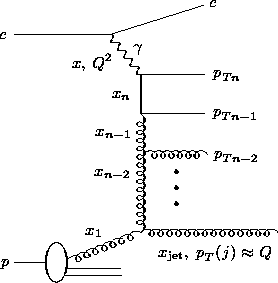
One of the dominant Feynman graphs responsible
for parton evolution in DIS
is shown in Fig. 10. The xi denote the momentum fractions
(relative to the incoming proton) of the incident virtual partons
and pTi is the transverse momentum of emitted parton i.
Such ``ladder-type'' diagrams with strong ordering in transverse
momenta,  , but only soft
ordering for the longitudinal fraction
 are the source of the leading log Q2 contributions which are summed in the
DGLAP evolution equation [43].
In the BFKL approximation, transverse momenta are no longer
ordered along the ladder while there is a strong ordering in the fractional
momentum
 .
BFKL evolution can be enhanced and DGLAP evolution suppressed by studying
DIS events which contain an identified jet of longitudinal momentum
fraction xjet=pz(j)/Eproton (in the proton direction)
which is large compared to Bjorken x [44].
Furthermore, tagging a forward jet
with  allows little room for
DGLAP evolution while the condition
 leaves BFKL evolution
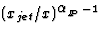
active. Assuming BFKL dynamics leads to an enhancement of the forward jet
production cross section proportional to
 ,where
 is the BFKL pomeron intercept, compared to
the
 QCD calculation with DGLAP evolution [46].
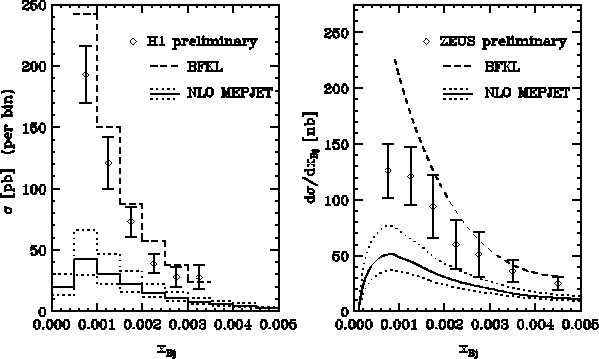 |
In Fig. 11, recent data from H1 [47] and
ZEUS [48] are compared with BFKL predictions [49]
and fixed order QCD predictions as calculated with the MEPJET [32]
program at NLO. The conditions and
are satisfied in the two experiments by slightly different
selection cuts. H1 selects events with a forward jet of pT(j)>3.5 GeV
(in the angular region 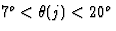 ) with
 |
(1) |
 with
 |
(2) |
Clearly, both experiments observe substantially more forward jet events
than expected from NLO QCD. A very rough estimate of the uncertainty of
the NLO calculation is
provided by the two dotted lines, which correspond to variations
by a factor 10 of the renormalisation and factorisation scales
 and
 .
A recent BFKL calculation (dashed lines) agrees better with the data, but
here the overall normalisation is uncertain and the agreement may be
fortuitous. Also, we recall that both experiments observe more centrally
produced dijet events than predicted by the NLO QCD calculations. Whatever
mechanism is responsible for the enhancement in central jet production
may also play a role in the enhanced forward jet cross section.
Clearly these issues must be resolved before the evidence for BFKL dynamics
can be elevated to the status of discovery.
The multiple gluon emission in ladder-type diagrams
is also studied in jet-jet decorrelations at the Tevatron.
D0 presented preliminary results as a function of the
pseudorapidity separation of the two leading jets in an event [50].
The measurement is compared
to HERWIG and PYTHIA [5] parton-shower Monte Carlo simulations, and to
BFKL predictions. The soft gluon
emissions are expected to decorrelate the transverse energy (ET) and
azimuthal angle ( ) of the produced jets as the rapidity interval
between them increases.
HERWIG and PYTHIA simulations reproduce the observed
decorrelation reasonably well. However, the leading-log BFKL
resummation [51]
predicts a larger decorrelation while a NLO QCD calculation underestimates
the decorrelation effects.
Therefore, no clear conclusion on the question of BFKL dynamics can be
drawn from the present Tevatron data.
latex2html conversion by www person on 1997/08/13
 with
 and 10,
which provides a measure for the uncertainty of the NLO prediction.