Hadronic production of W and Z bosons provides a clean probe
of perturbative QCD calculations. Three analyses were
presented from the DØ and CDF collaborations utilising the large
sample of  collisions accumulated from the 1994-1995 Tevatron Collider
run [54].
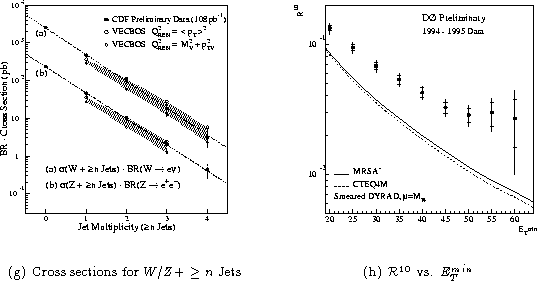
The first analysis from the CDF collaboration was a measurement of the
 Jets cross sections for n=1-4. Figure 12(a)
shows the inclusive associated jet multiplicity distribution for W and Z
bosons. The uncorrected data are compared to the CDF detector simulation
incorporating the VECBOS [55]
LO QCD calculation plus HERWIG [6]
parton shower and hadronisation.
The CTEQ3M [30]
parton densities were used. The band in the theoretical
predictions represents the effect of varying the renormalisation and
factorisation scales from Q2=M2+pT2 of the boson to the
 of the partons. Using the hard scale, M2+pT2, the
LO QCD predictions are about a factor 1.7 lower than the data, for all jet
multiplicities. On the other hand the predictions for the softer scale,
, are in better agreement with the data.
The DØ collaboration reported results on the ratio of the production
cross sections for W + 1 Jet to W + 0 Jets,  , as a function
of the minimum jet transverse energy, shown in Fig. 12(b). The
data between 20 and 60 GeV are consistently higher than the DYRAD NLO
predictions by about a factor of two. This
is a rather curious result since it is in a domain where one generally expects
QCD to work well.
DØ also investigated color coherence effects in W + Jets events. For this study events with a W boson and opposing jet were selected and the distribution of soft particles around the colorless W boson and the jet (colored parton) was measured. The color coherence signal is observed by comparing the multiplicity distributions of calorimeter towers with ET > 250 MeV around the W and around the jet. It is concluded that both angular ordering and string fragmentation are needed in PYTHIA [5] to describe the data.
latex2html conversion by www person on 1997/08/13