


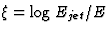
 for particles with energy E in a jet of energy
Ejet--the famous ``hump-back plateau'' [2].
Due to the intrajet coherence of gluon radiation, not
the softest partons but those
with intermediate energies (
 )multiply most effectively in QCD cascades.
The shapes of the measured particle energy spectra in e+e- annihilation
turn out to be surprisingly close, over the whole momentum range down to
momenta of a few hundred MeV, to the perturbative predictions based on the
Modified Leading Log Approximation (MLLA) [3].
These observations can be taken as evidence that the perturbative phase
of the cascade development indeed leaves its imprint on the
final state hadrons. This, in turn, suggests that the
conversion of partons into hadrons occurs at a low
virtuality scale (of the order of the hadron masses), independent of the
scale of the primary process, and involves only low-momentum transfers.
This Local Parton-Hadron Duality (LPHD) may be connected
to pre-confinement properties of QCD which ensure that colour charges are
compensated locally [13].
LPHD remains, however, a strong hypothesis
that is supposed to be valid only in an inclusive and average sense.
With LPHD, only two essential parameters are involved in the
perturbative description:
the effective QCD scale  and a (transverse momentum)
cut-off parameter Q0, resulting in a highly constrained theoretical
framework; non-perturbative effects are essentially reduced to
normalisation constants.
New data on charged particle spectra were presented at this workshop
by H1 [14], ZEUS [15] and CDF [16].
The HERA experiments concentrate
on the current
fragmentation region in DIS and perform the analysis in the
Breit frame, where the exchanged boson is completely spacelike.
The new data confirm with much increased statistical significance
the features observed in e+e-: approximately Gaussian shape of the
 spectra with peak-position and width increasing with Q
as predicted in MLLA. Moreover, for sufficiently large Q,
they demonstrate the expected equivalence of the current region with
one hemisphere of an e+e- event.
With increasing luminosity being accumulated at HERA, this work
should be extended to include moment and cumulant analyses
of the spectra for which detailed predictions exist [3].
Beautiful confirmation of the MLLA+LPHD approach has been presented
by CDF [16]. This experiment studies charged particle momentum
distributions in subsamples of dijet events. For fixed dijet masses
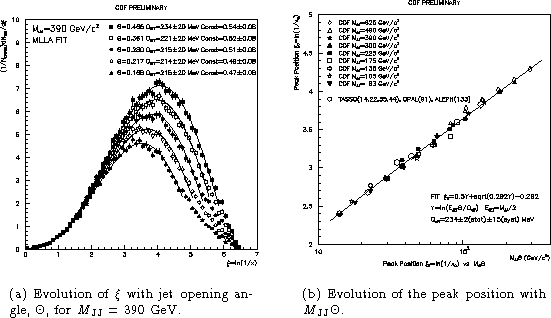
(hence fixed jet energy) in the range 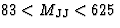 GeV,
the distribution of tracks, within cones of various opening
angle
 (with respect to the jet axis), is
studied (see Fig. 1(a)).
As dijet mass
 jet opening angle
increases, the peak of the spectrum,
 ,shifts towards larger values
of in perfect agreement with MLLA predictions and
e+e- data, as shown in Fig. 1(b).
Similar analyses should be possible in DIS and photoproduction
at HERA but have not yet been attempted.
 |
Although present data on charged particles appear to confirm strikingly the perturbative approach to soft hadronisation, the situation is less clear-cut when spectra of identified particles/resonances are examined. At LEP, the conclusion is unambiguous: the peak positions do not agree with the naively expected mass dependence. Here also, data on spectra of different hadron species and from different jets at the Tevatron and HERA would be most helpful.
latex2html conversion by www person on 1997/08/13