


The Schottky diodes fabricated with VPE GaAs behaved according to simple theory, that is without the presence of a significant concentration of deep traps. Titanium-GaAs barrier heights of  eV and
 eV were measured which are closed to those quoted in the literature. The reverse current-voltage characteristic did not saturate, an effect attributed to generation current in the depletion region. The donor concentration was obtained via CV analysis of the material to be
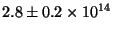 cm
 , which prevented the extension of the depletion region beyond
 30
 m before breakdown occurred, due to the high bias required (
 200 V). Charge collection experiments were limited due to the small depletion region. The charge collection efficiencies obtained from front alpha particle and 60keV gamma irradiation were close to 100%.
After a 24GeV/c proton fluence of
 cm
 the VPE diode had a reverse current density measured at 100V reverse bias and 300 K, of
 Acm. This may be compared to
 Acm for an LEC diode after the same fluence. The current increase for the VPE diode was over an order of magnitude. It must be noted, however, that the VPE diode was not guarded and a guarded ring could reduce the current due to a reduction in surface currents. Deep levels were introduced. From the increase in resistance and the capacitance-voltage dependence the deep levels were appear to be acceptors. A fall in charge collection efficiency from front alpha illumination was observed and at a reverse bias of 200 V the cce fell from 100% to
 %.
In comparison with a typical LEC diode the VPE diode had a lower leakage current before irradiation, but this was not true after the radiation fluence. Charge collection from a SI-U detector was considerably worse than in the VPE device both before and after the radiation fluence. The small depletion width of the VPE diode, however, means that the results can not be directly compared.
The material could be very promising for detector development if the free carrier concentration can be reduced to allow an increased depletion width. The materials radiation hardness is still a cause for concern.