


glasDept. of Physics & Astronomy, University of Glasgow, UK epiEpitronics Corporation, Phoenix, Az., USA Partially supported by a CASE award from the Rutherford Appleton Lab , UK
On Behalf of the RD8 Collaboration
GaAs Schottky diode particle detectors have been fabricated upon Low Pressure Vapour Phase Epitaxial GaAs. The devices were characterised with both
electrical and charge collection techniques. The height of the Ti-GaAs barrier used was determined via two electrical methods to be  and
 eV. The current density was greater than that expected for an ideal Schottky barrier and the excess current was attributed to generation current in the bulk of the material. A space charge density of
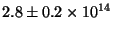 cm
 was determined from capacitance voltage characterisation. The charge collection efficiency was determined from front alpha illumination and 60 keV gamma irradiation to be greater than 95% at a reverse bias of 50 V.
The diodes were characterised after an exposure to a radiation fluence of
 24GeV/c protons cm
 . The reverse current measured at 20
 C increased from 90 nA to 1500 nA at an applied reverse bias of 200 V due to the radiation induced creation of extra generation centres. The capacitance measurements showed a dependence upon the test signal frequency which is a characteristic of deep levels. The capacitance measured at 5 V reverse bias with a test frequency of 100 Hz fell with radiation from 300 pF to 40 pF due to the removal of measurable free carriers. The charge collection of the device determined from front alpha illumination also fell to
 % at a reverse bias of 200 V.