


Next: Annealing studies
Up: The effects of radiation
Previous: Reverse Current
The charge collection efficiencies for 200 m thick detectors as a function of neutron, proton and pion fluence are shown in figures 5, 6 and 7. These were measured using minimum ionising particles (mips) from a 90Sr source at an applied bias of 200V. The reduction in cce with fluence occurs at a greater rate for pions and protons than for neutrons. A 10000 electron signal response to the 90Sr source, (
 40% cce), is obtained after 1.4
 1014 n/cm2, 6.0 1013 p/cm2, and only 3.0 1013
 /cm2. The cce falls rapidly initially and then at a slower rate for higher fluences with the position of the change in gradient depending upon the particle type.
Figure 5:
The cce of 200m thick GaAs detectors as a function of neutron fluence, measured at 200V and 20oC.
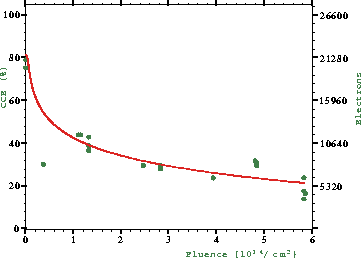 |
Figure 6:
The cce of 200m thick GaAs detectors as a function of proton fluence, measured at 200V and 20oC.
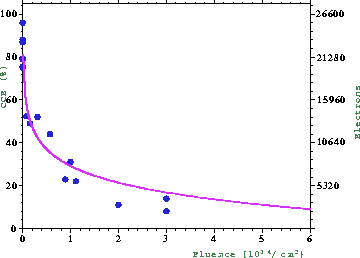 |
Figure 7:
The cce of 200m thick GaAs detectors as a function of pion fluence, measured at 200V and 20oC.
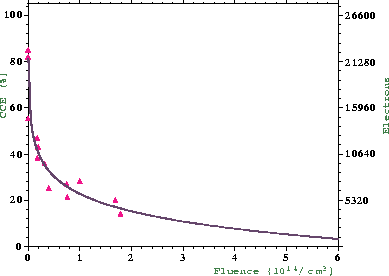 |
In the ATLAS experiment at the LHC a particle flux of 0.12 1014 /cm2/year at the position of the GaAs wheels has been calculated [7] for full luminosity. This means that after only two years at full luminosity the pion fluence would be sufficient to reduce the signal from a 200m thick detector to approximately 10000 electrons. The neutron flux is the only other significant contribution and this has been calculated to be a factor of 3 to 10 times less than the pions. The exact value depends upon the moderator used in the calorimeters. After the 10 years expected operational lifetime of ATLAS the neutron fluence will not be enough to reduce the signal to less than 10000 electrons.
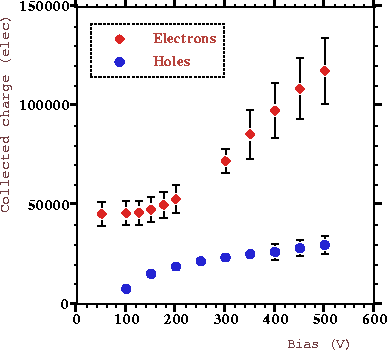
Irradiated 200m thick detectors biased in excess of 200V demonstrate an increase in cce. For example for a 160m thick detector irradiated to a fluence of 1.0 1014 p/cm2 the signal increased from 8500 electrons at 200V to 12000 electrons at 400V. The reason for the increase in signal can be understood from the electron and hole collection data. Before irradiation, the signal due to the holes is greater than that due to the electrons, implying that the electrons are trapped more than the holes. The signal due to the holes however falls at a faster rate with fluence than that due to the electrons. This means that both electron and hole traps are introduced with irradiation, while the electron trapping is the less important after irradiation contrary to what is observed in unirradiated detectors. The electron signal, which is constant for a bias up to Vfd, rises at greater applied biases as shown in figure 8. The hole signal remains almost constant with increasing bias after its initial steep rise at Vfd. From this it is possible to conclude that field-enhanced electron detrapping may be present.
Figure 8:
The charge collected from electrons and holes as a function of bias for a 160m thick GaAs detector after a fluence of 3 1014 p/cm2.
 |
As the mip signal for a GaAs detector irradiated in excess of 1.0 1014 p/cm2 appears to be independent of substrate thickness, even at an applied bias much larger than Vfd, it is proposed that the carriers have a mean free path less than or equal to the thickness of the thinnest detector tested, that is 115m. The charge deposited by a mip, Qdep is given by
|  |
(2) |
where W is the width of the detector and dE/dx is the energy loss per unit length of detector traversed. If the carrier has a mean free path,  , then the charge collected, Qcol, is
|  |
(3) |
thus
|  |
(4) |
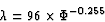
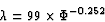
The fitted values of , which is a function of the fluence, for proton and pion irradiation are given by equations (5) and (6), and show a similar fluence dependence.
|  |
(5) |
|  |
(6) |
Next: Annealing studies
Up: The effects of radiation
Previous: Reverse Current
latex2html conversion by www person on 1997-08-27