


The change in the reverse current of a detector irradiated to 1.0  1014 p/cm2 has been measured over a period of time greater than 1 year. The sample was stored at room temperature, which varied throughout the year from 18oC to 25oC. All the current measurements were carried out at 20oC with the same Keithley 237 voltage source measurement unit. The first current measurement was performed 20 days after the irradiation period due to the initial activity of the sample and holder preventing earlier handling. The value of the reverse current, Ir, at Vfd reduced with time (t), in hours, with a logarithmic dependence given by
 |
(7) |
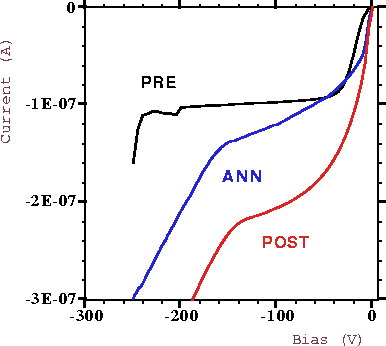
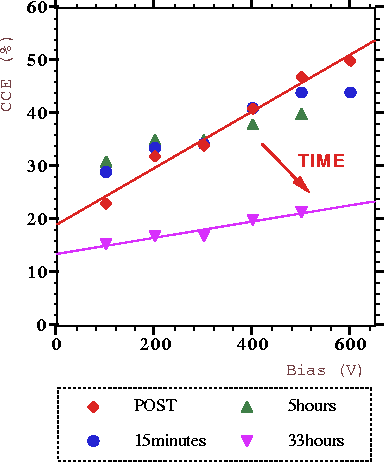
Elevated temperature annealing, for periods ranging from 15 minutes to 33 hours, was performed on six irradiated detectors in an oven at 210oC in air without bias. The reverse current and charge collection efficiency variations for a 180 m thick detector irradiated to 1.0 1014 p/cm2 are shown in figures 9 and 10. The reverse current decreased after an 33 hour anneal from 0.22A to 0.14A (corresponding to 30nA/mm2 to 20nA/mm2) where the unirradiated value was 0.10A (14nA/mm2). The full depletion voltage remained unaffected by the annealing. For an applied bias of 100V the cce increased from 23% to 30% for annealing times up to 5 hours. As the bias increased, the increase in cce for the annealed detector was at a slower rate than in the pre-annealed case, resulting in a lower cce for the annealed detectors at biases in excess of 400V. For longer anneal times the cce decreased. For an anneal time of 33 hours, for example, the cce was only 15% at 100V rising to 22% for a maximum applied bias of 500V.
 |
 |
The arsenic antisite defect in GaAs is known to anneal at temperatures in excess of 450oC [8]. As the irradiation could produce such antisite defects the effect of annealing at 450oC was investigated. A flash-lamp anneal was used to illuminate the detectors for either 30,60,90, or 120 seconds. The effect was shown to be independent of the detector side which was illuminated, demonstrating that the whole bulk was being heated. The plateau reverse leakage current was reduced but so was the full depletion voltage. For an applied bias greater than Vfd the annealed current was greater than before annealing with the gradient of this section of the current characteristic being quite large. The mip cce of the detector was increased for applied biases less than Vfd, however due to the large increase in leakage current above Vfd it was not always possible to measure the charge collection at a higher applied bias. The increase in mip cce was due to an increase in electron mean free path with anneal time while the hole mean free path remained unchanged. A bias of 300V, which could be applied to a detector annealed at 450oC for 120s after a fluence of 1.7 1014  /cm2, gave a mip cce of 71%. The pre-irradiation cce was 95% and the post-irradiation, pre-anneal value was 26%.
latex2html conversion by www person on 1997-08-27